
Manual Handling Training for Nurses and Healthcare Workers
Patient handling theory for hospitals, clinics, day surgeries and community health. The modules and assessment are free; pay A$49 for your Certificate of Completion only when you pass.
- 100% online, on any device
- Written for nurses, AINs, orderlies and clinic staff
- Bed mobility, lateral transfers, hoists, lines and drains, falls
- Complete at your own pace between shifts
- Instant certificate after successful completion and payment
Content last reviewed September 2026.
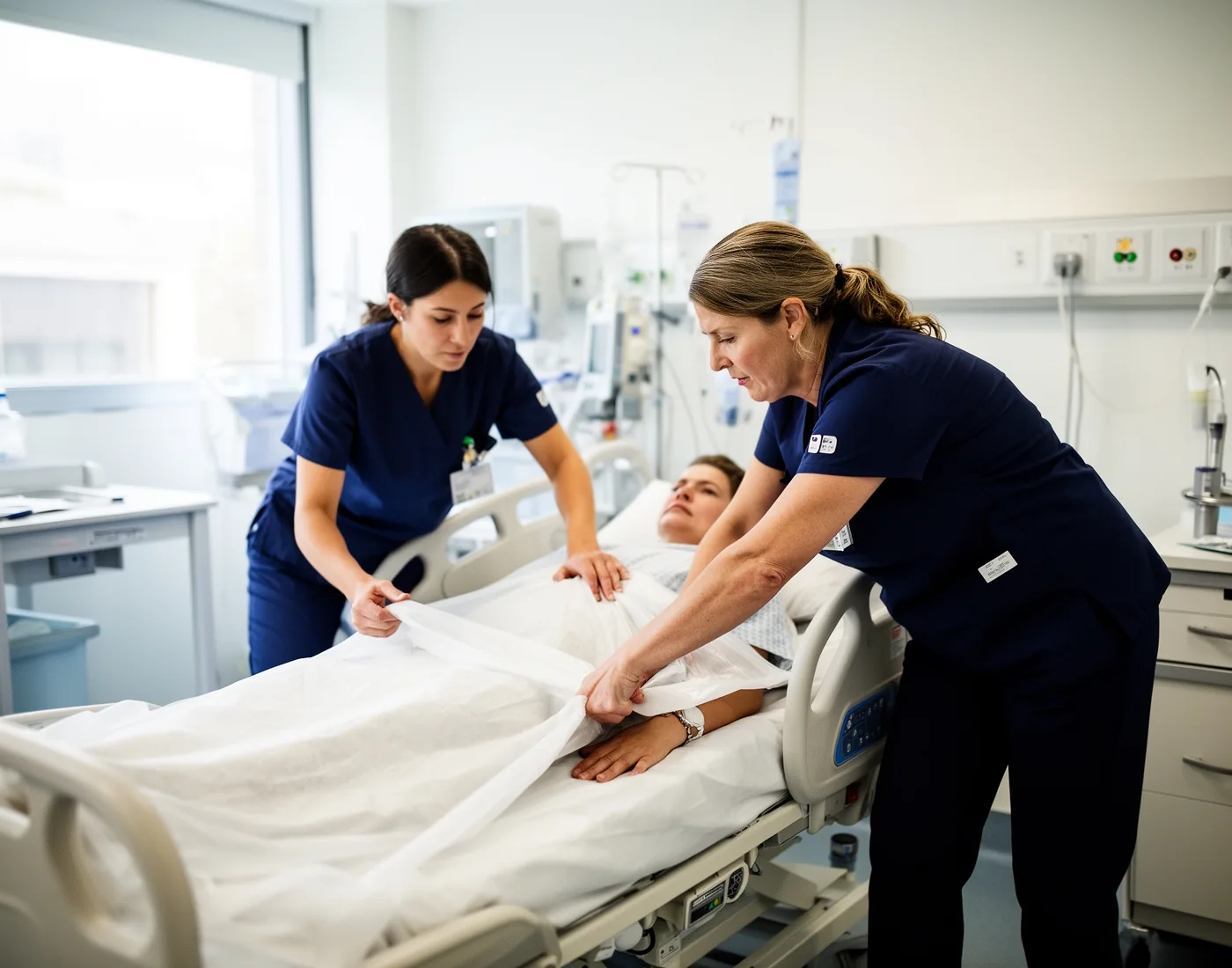
100% Online
Complete the training on your phone, tablet or computer, at work or at home.
Clinically Focused
Built around real ward, theatre, emergency and clinic tasks, not warehouse lifting.
Online Assessment
A 20-question assessment checks your understanding of every module.
Certificate of Completion
Download your certificate after passing the assessment and paying A$49.
Who Is This Training For?
This course is for people who handle patients and clinical equipment in Australian hospitals, private clinics, day surgeries, general practice and community health — whether you are new to healthcare or refreshing the theory behind your workplace competencies.
Registered and Enrolled Nurses
Ward, theatre, emergency, critical care and community nursing.
Assistants in Nursing
AINs and nursing assistants providing bedside care.
Patient Services Assistants and Orderlies
Transporting patients, beds and equipment across the hospital.
Allied Health Assistants
Supporting physiotherapy, occupational therapy and rehabilitation.
Clinic and General Practice Staff
Practice nurses and treatment room staff working with fixed-height couches.
Nursing Students on Placement
Preparing for clinical placement and the ward's practical competency.
This training supports safe work knowledge. It does not replace your health service's mandatory competencies and does not guarantee employment.

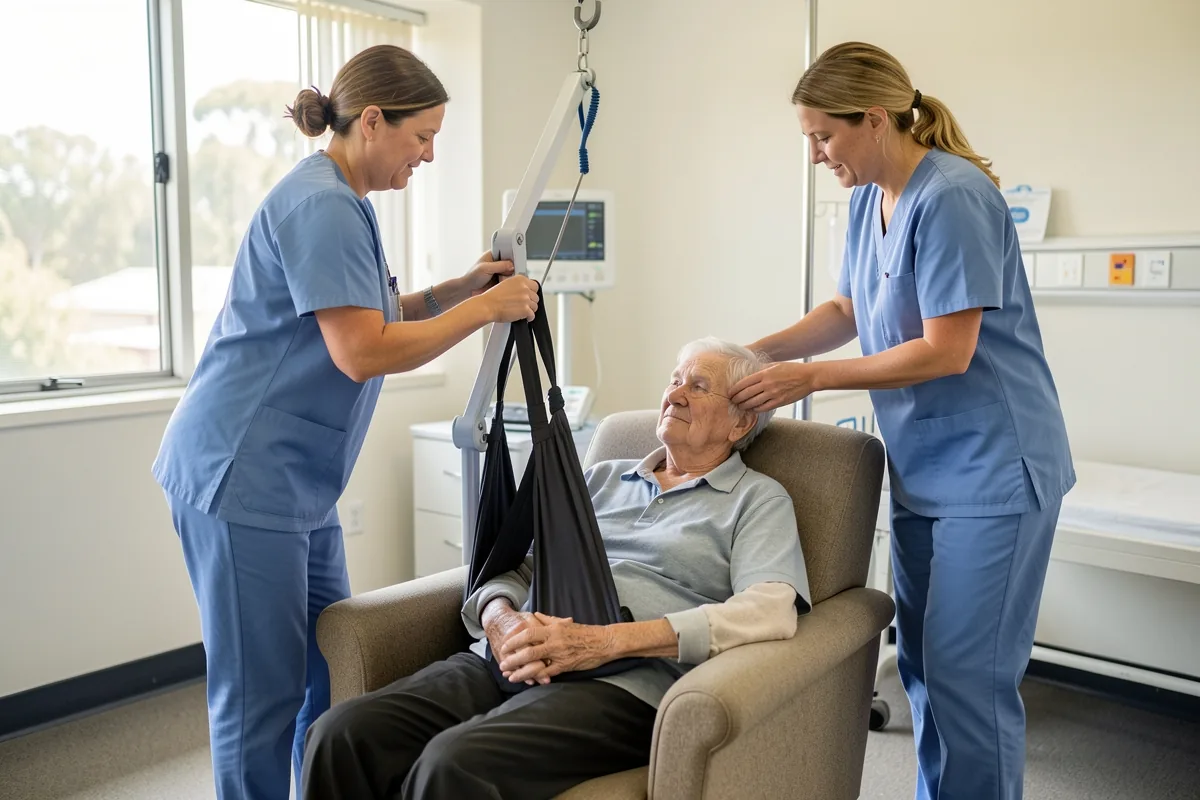

Why Manual Handling Matters in Nursing and Healthcare
Nurses, assistants in nursing and orderlies record more body stressing injuries than almost any other occupation in Australia. The tasks are routine — a turn, a slide, a stand — but they are repeated across every shift with patients who are unwell, sedated, attached to equipment and sometimes unpredictable. Poorly controlled, they injure staff and patients alike.
- Rolling and repositioning patients in bed
- Moving patients up the bed with slide sheets
- Lateral transfers between bed, trolley and theatre table
- Assisting patients from sitting to standing
- Bed-to-chair and chair-to-toilet transfers
- Mobilising patients with IV poles, drains, catheters and oxygen
- Lowering a falling patient and assisting a patient from the floor
- Hoist and stand-aid transfers
- Pushing beds, trolleys and wheelchairs between departments
- Positioning anaesthetised patients in theatre and recovery
- Caring for bariatric patients with specialist equipment
- Unpacking stores, fluids and oxygen cylinders
Safe patient handling is more than “lift with your legs”
Technique alone is not a reliable control in a hospital. Managing hazardous manual tasks means assessing the patient and the task, using the right equipment and the right number of staff, and following your health service's no lift or minimal lift policy before any force is applied.
- 1Identifying hazardous tasks on your unit
- 2Checking the patient's transfer status
- 3Reassessing the patient today, not yesterday
- 4Counting the attachments and assigning them
- 5Preparing the bed, space and equipment
- 6Using hoists, slide sheets and boards as trained
- 7Waiting for the staff the procedure requires
- 8Reporting hazards, near misses and early symptoms
Four Simple Steps
Learn first, pay last. You can complete the entire training and assessment before making any payment.

Complete the Training
Work through the online modules at your own pace, on any device.
Pass the Assessment
Complete the online multiple-choice assessment. Required score 75%. Unlimited attempts, and a retry only asks about the questions you got wrong.
Enter Your Details and Pay A$49
After passing, enter the information that will appear on your certificate and proceed to secure payment.
Get Your Certificate
After successful payment, access your Certificate of Completion.
Eight Focused Learning Modules
Estimated course duration: approximately 45–60 minutes.
- Module 1
Introduction to Manual Handling in Nursing and Healthcare
6–8 minutes
- Module 2
Australian Work Health and Safety Principles
6–8 minutes
- Module 3
Identifying Hazardous Manual Tasks
6–8 minutes
- Module 4
Risk Assessment and Risk Controls
6–8 minutes
- Module 5
Safe Movement Principles
5–7 minutes
- Module 6
Patient Handling in Clinical Settings
9–11 minutes
- Module 7
Clinical Equipment and Handling Aids
6–8 minutes
- Module 8
Reporting, Incidents and Ongoing Safety
5–7 minutes

Ready to Take the Assessment?
Complete the training first, then take the online assessment. Pass with 75% or higher to unlock your certificate for A$49.
Unlimited attempts. No subscription. No hidden fees.
Nursing & Healthcare Manual Handling FAQ
No. Every health service runs its own mandatory manual handling or safe patient handling training, usually with a practical assessment on its own hoists, slide sheets and beds. That competency is assessed in person and cannot be replaced by an online course.
This course gives you the theory those sessions build on — the risk factors, the hierarchy of controls, no lift principles, bed mobility, lateral transfers, falls and equipment — so that the practical session makes sense and you arrive prepared.
Yes. Many students take it before their first clinical placement so that terms like transfer status, two assist, stand-aid and lateral transfer are familiar before they meet them on the ward.
Your university and the placement hospital will still require their own manual handling training. Treat this as preparation, and always work within your scope and under your facilitator's direction on placement.
Yes. The course assumes no prior training. It starts from what a manual task is and builds up to patient handling, equipment and reporting, using ward scenarios rather than theory alone.
Where it uses clinical terms — chest drain, profiling bed, safe working load — it explains them in context.
Yes. Module 6 covers planning bariatric care from admission, checking the safe working load of every item the patient will use, air-assisted lateral transfers, staffing, body shape and dignity, and Module 7 covers bariatric hoists, slings and beds.
It is theory. Your health service's bariatric procedure and equipment training take precedence.
Yes. Module 6 works through mobilising and transferring patients with IV lines, urinary catheters, chest and wound drains, oxygen and monitoring, and covers the anaesthetised patient in theatre and recovery, emergency department handovers and the fallen patient.
Some nurses record self-directed learning such as this course as continuing professional development according to their own registration requirements. The course is not an endorsed or accredited CPD activity, so it is your responsibility to decide whether it meets your requirements and to keep your own record and reflection.
Yes. The scenarios include general practice treatment rooms with fixed-height couches, day surgery recovery, and community nursing in patients' homes where nothing was designed for care, as well as acute wards, emergency and theatre.
Most learners allow approximately 45–60 minutes across the eight modules and the assessment, and you can stop and resume between shifts. The training and assessment are free to complete; you pay A$49 only if you pass and want the Certificate of Completion.
75% on the 20-question assessment. Attempts are unlimited, and a retry only asks you to revisit the questions you got wrong.
Many employers accept it as evidence of manual handling theory knowledge, alongside their own mandatory competency and orientation. Public health services in particular will still require you to complete their own training, so check with your educator or manager if you are unsure.
Every certificate has a unique number that an employer can verify online or by scanning the QR code.
No. This is non-accredited online workplace training and issues a Certificate of Completion. It is separate from the nationally recognised unit HLTWHS005 Conduct manual tasks safely and does not provide a Statement of Attainment.
General questions about pricing, verification and accreditation status are answered on the site-wide FAQ.
Related manual handling courses
- Manual Handling Training for Aged Care WorkersResidential, home and community aged care: repositioning, transfers, hoists, slide sheets and reporting changes in a resident's mobility.
- Manual Handling Training for Disability Support WorkersNDIS, community and in-home support: transfers, hoists and slide sheets, wheelchairs and vehicles, and working alone in a participant's home.
- Manual Handling Training for Cleaning and Facilities StaffCommercial cleaning, housekeeping and maintenance: carts and bins, mopping and vacuuming, bed-making, chemicals and equipment, repetitive reaching.
Nursing & Healthcare Manual Handling Questions, Answered
Ready to Get Started?
Complete your nursing & healthcare manual handling training online at your own pace.
A$49 certificate after successful assessment.