
Manual Handling Training for Cleaning and Facilities Staff
Free online training and assessment. Pay A$49 for your Certificate of Completion only when you pass.
- 100% online
- Written for cleaners, housekeepers and facilities staff
- Complete at your own pace, between shifts
- Online assessment included
- Instant certificate after successful completion and payment
Content last reviewed September 2026.
100% Online
Complete the training on your phone, tablet or computer, at any hour.
Cleaning Focused
Mopping, vacuuming, bins, bathrooms, housekeeping and machines — the actual tasks of a cleaning shift.
Online Assessment
Demonstrate your understanding through a 20-question final assessment.
Certificate of Completion
Download your certificate after successfully passing and paying A$49.
Who Is This Training For?
This course is designed for people working, or preparing to work, in cleaning and facilities roles across Australia — commercial and office cleaning, schools and universities, hospitals and healthcare, hotels and accommodation, domestic and NDIS home cleaning, facilities maintenance, caretaking, grounds and waste handling, including contract teams working nights and alone.
Commercial & Office Cleaners
Offices, retail and shopping centres, often after hours.
Facilities & Maintenance Staff
Caretakers, groundskeepers and building services teams.
Hospital & Healthcare Cleaners
Wards, clinics and aged care facility cleaning teams.
Hotel Housekeepers
Room servicing, bed-making, linen and room carts.
Domestic & NDIS Home Cleaners
Cleaning in private homes with the client's own equipment.
Contract Cleaning Teams
School and university cleaners, waste handlers and night crews.
This training supports safe work knowledge. It does not guarantee employment.
Why Manual Handling Matters in Cleaning
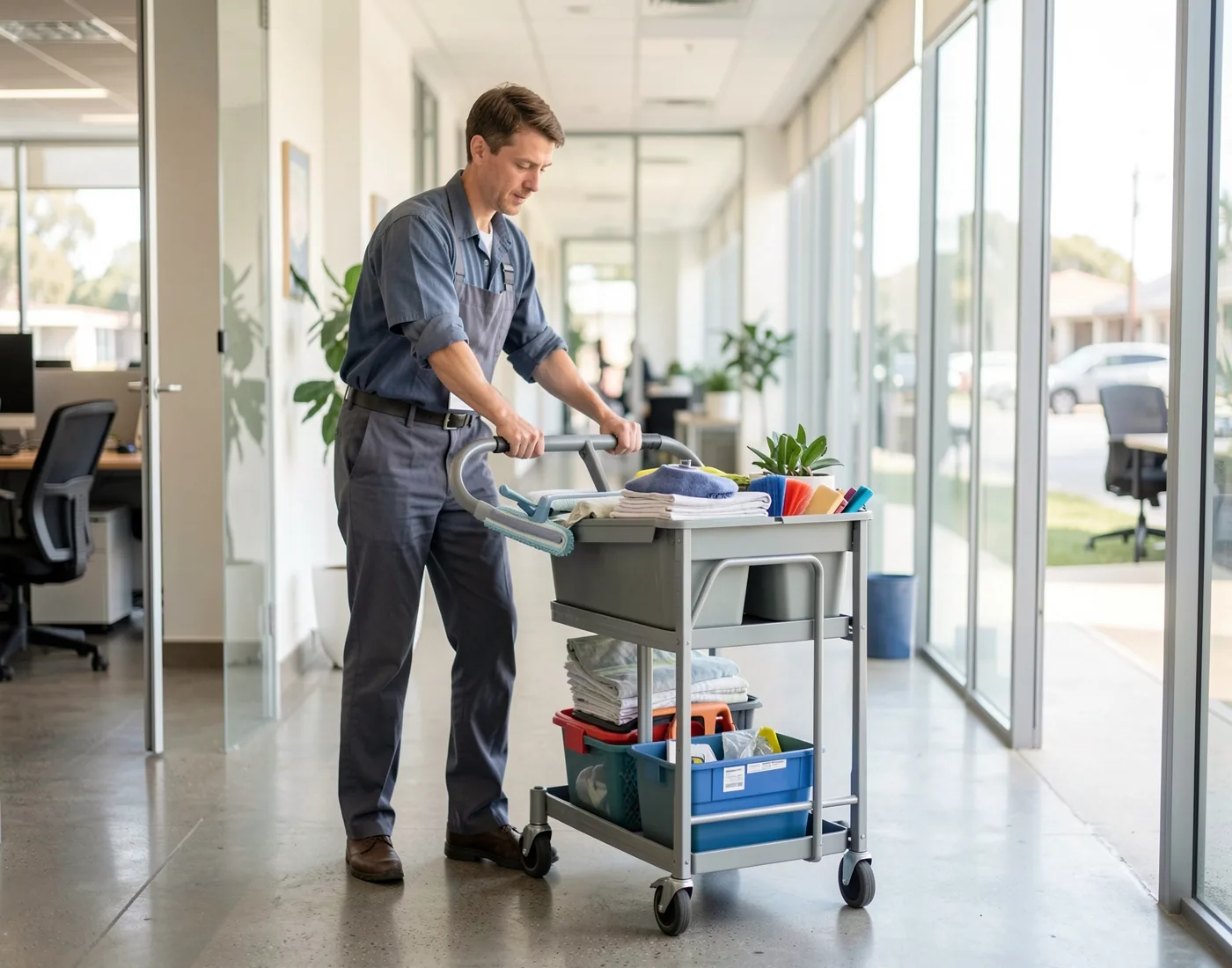
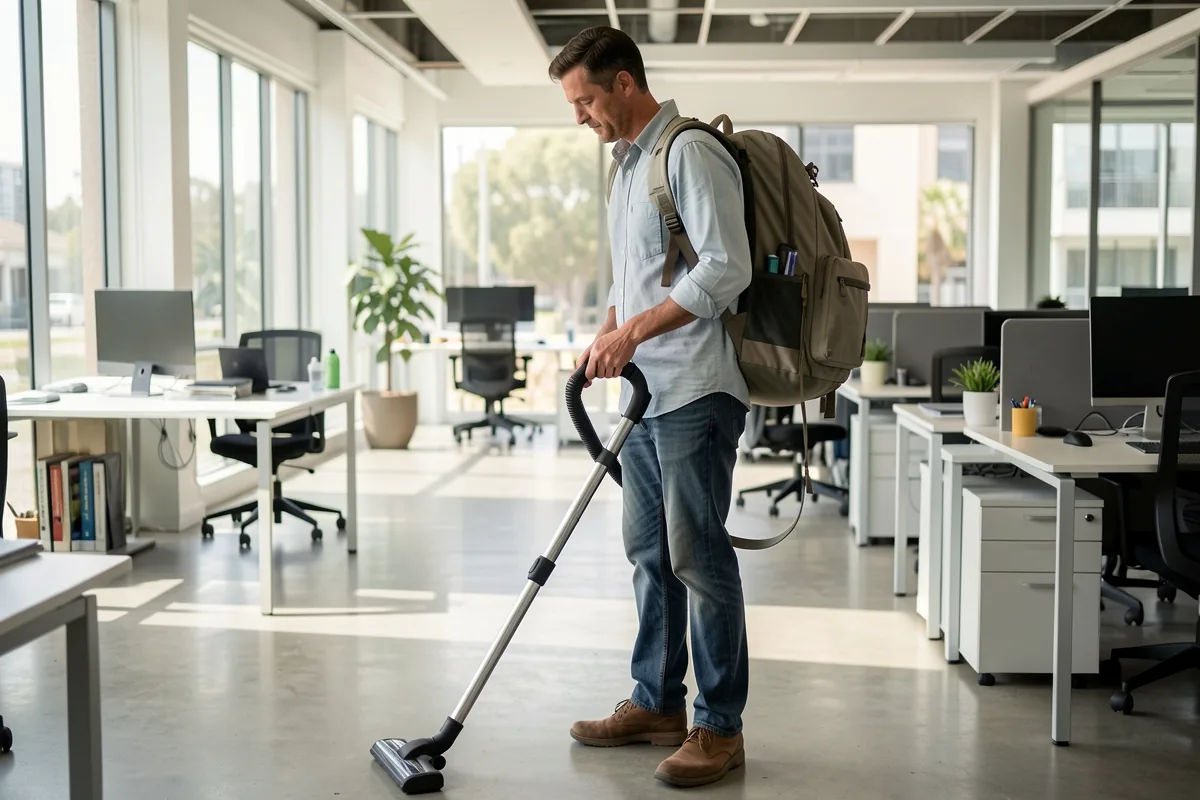
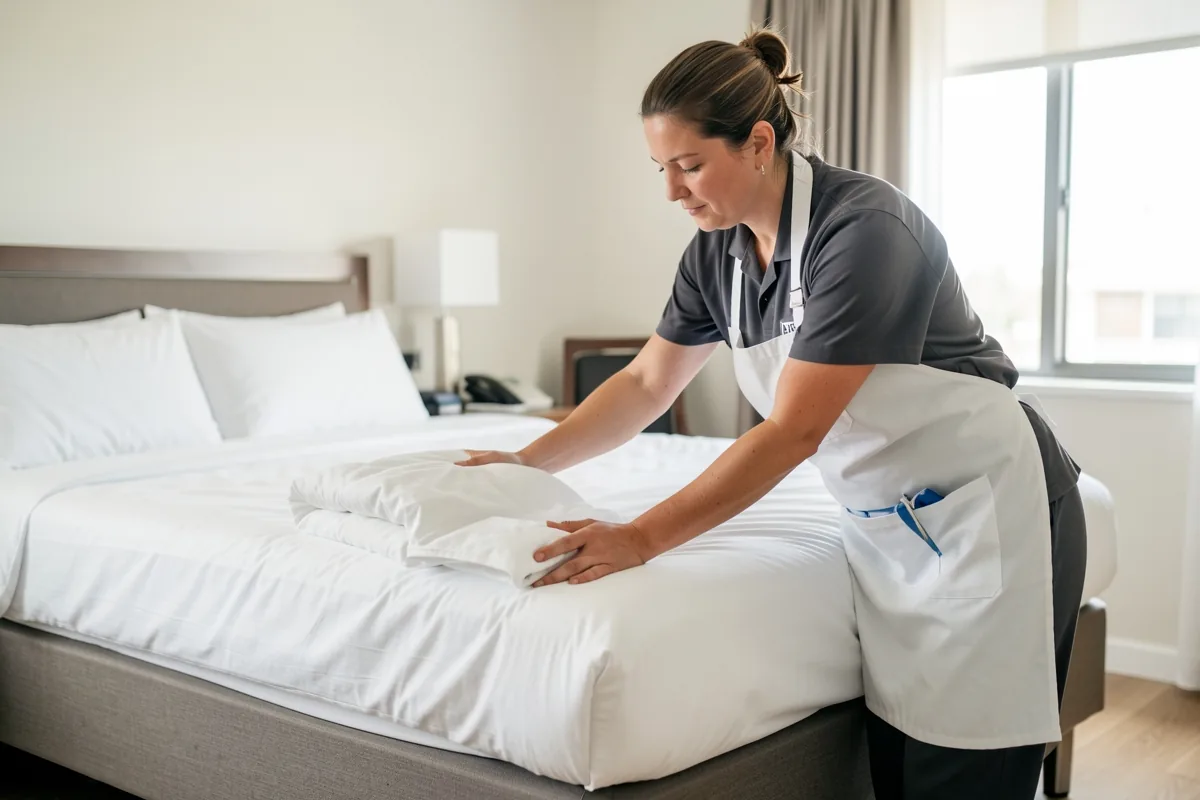
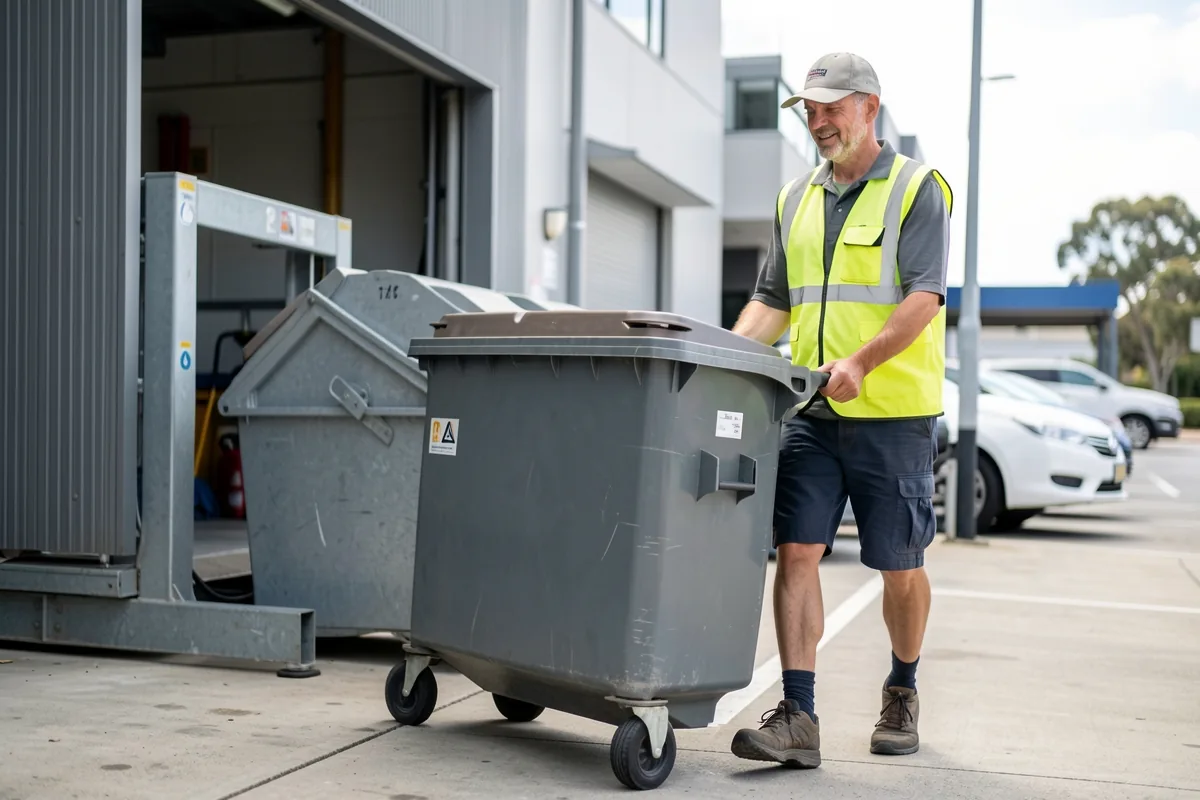
Cleaners and housekeepers are consistently among the occupations with the highest rates of musculoskeletal injury claims in Australia. Almost nothing in a cleaning shift is heavy. The injuries come from light tasks repeated hundreds of times in poor postures, under area-per-hour targets, with the occasional bin bag that weighs far more than it looked.
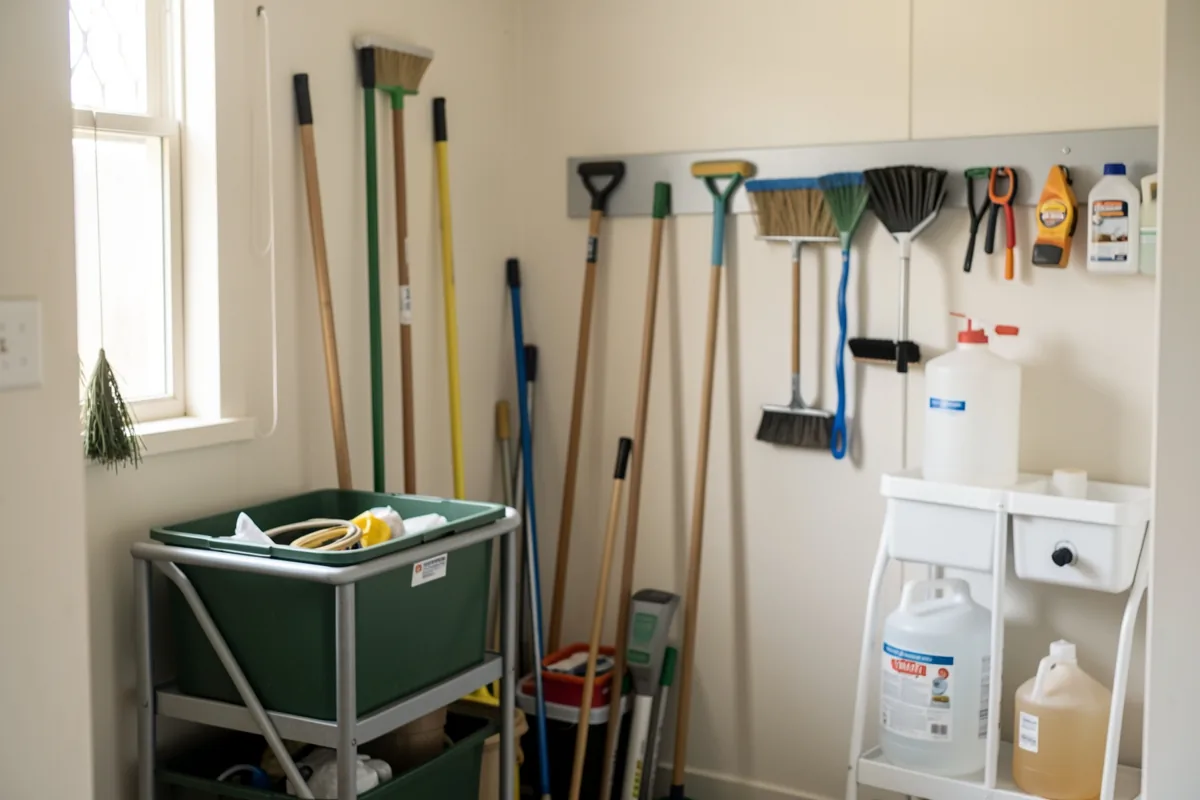
- Mopping with a bucket or a flat mop system
- Vacuuming with uprights and backpack vacuums
- Emptying bins and carrying bags to skips and hoppers
- Pushing loaded janitorial carts and housekeeping trolleys
- Carrying buckets, water and chemical containers
- Kneeling and twisting to clean bathrooms
- High dusting and reaching above shoulder height
- Moving furniture to clean under and behind it
- Making beds, turning mattresses and handling linen bags
- Steering buffers and scrubbers, and moving them between floors
- Working alone at night in unfamiliar buildings
Safe manual handling is more than “lift with your legs”
Technique alone does not change a chest-high hopper, a low bed or a string mop. Managing hazardous manual tasks means working through a risk management process — and choosing the right equipment and pace — before force is ever applied.
- 1Identifying the hazardous tasks on each site
- 2Assessing the task as it is actually done
- 3Considering the load — especially unknown weights
- 4Considering the environment — stairs, lifts, wet floors
- 5Using the right equipment: carts, wheels, poles, dispensers
- 6Following your employer's and the site's procedures
- 7Waiting for a second person when a task needs one
- 8Controlling the risk as high in the hierarchy as practicable
Four Simple Steps
Learn first, pay last. You can complete the entire training and assessment before making any payment.

Complete the Training
Work through the online modules at your own pace, on any device.
Pass the Assessment
Complete the online multiple-choice assessment. Required score 75%. Unlimited attempts, and a retry only asks about the questions you got wrong.
Enter Your Details and Pay A$49
After passing, enter the information that will appear on your certificate and proceed to secure payment.
Get Your Certificate
After successful payment, access your Certificate of Completion.
Eight Focused Learning Modules
Estimated course duration: approximately 45–60 minutes.
- Module 1
Introduction to Manual Handling in Cleaning and Facilities Work
6–8 minutes
- Module 2
Australian Work Health and Safety Principles
6–8 minutes
- Module 3
Identifying Hazardous Manual Tasks in Cleaning
6–8 minutes
- Module 4
Risk Assessment and the Hierarchy of Controls
6–8 minutes
- Module 5
Safe Movement Principles
5–7 minutes
- Module 6
Cleaning Tasks and Housekeeping
8–10 minutes
- Module 7
Equipment, Aids and Tools for Cleaning Work
5–7 minutes
- Module 8
Reporting, Incidents and Ongoing Safety
5–7 minutes
Ready to Take the Assessment?
Complete the training first, then take the online assessment. Pass with 75% or higher to unlock your certificate for A$49.
Unlimited attempts. No subscription. No hidden fees.
Cleaning & Facilities Manual Handling FAQ
Yes. Bins and bags are the one load in a cleaning shift you cannot see inside, and Module 6 treats them as the highest sudden-force risk in the job: testing the weight before lifting, holding bags away from your body, never putting a hand in a bin, never lifting over the rim of a skip or hopper, and moving waste on wheels rather than by hand.
It also covers sharps found in general waste, shared responsibility for bin lifters and skips on client sites, and what to do when the compactor is out of order at 3 am.
It is written for exactly that situation. Working alone, out of hours, in buildings you do not know well, with lifts locked off and no supervisor on site is treated throughout as part of the risk — and the course is clear that a two-person task waits for two people, even at 3 am.
Module 2 and Module 8 also cover how consultation and reporting work when you rarely see a supervisor: site logs, apps, on-call numbers and escalation.
Yes. Module 6 includes a dedicated section on room servicing: bed-making on low frames, lifting mattress corners, mattress turning as a scheduled two-person task, linen and soiled bags, loading and pushing room carts, and why the room allocation itself is a manual handling control.
Yes. Home cleaning has its own version of the same hazards: the client's own vacuum and mop rather than professional equipment, furniture that must be moved, low baths and showers, and no colleague to share a lift. The principles — test the load, keep work between knee and shoulder height, use long-handled tools, do not move what you do not have to, and raise unsuitable equipment with your employer or the participant's plan — apply directly.
If you work through an agency or provider, their procedures and the participant's plan take precedence over anything in this course.
Usually both. Your employer typically supplies and maintains the cart, mop system, vacuums and machines; the client owns the bins, skips, compactors, bin lifters, lifts, sinks and storerooms. Under Australian WHS law both are PCBUs with duties towards you, and they are required to consult and co-ordinate with each other.
Module 2 and Module 7 explain this in practical terms, including what to do when a client's bin lifter has been broken for a month and each organisation says it is the other's problem. Your part is to report through your own employer every time.
Yes. It assumes no prior training and starts from what a manual task is, before moving on to the tasks, equipment and reporting specific to cleaning and facilities work.
Many people take it while applying for their first cleaning or housekeeping role to show they understand safe manual handling principles.
Most learners allow approximately 45–60 minutes, and you can stop and resume between shifts. The training and assessment are free to complete; you pay A$49 only if you pass and want the certificate.
75% on the 20-question assessment. Attempts are unlimited, and a retry only asks you to revisit the questions you got wrong.
Many contractors and facilities teams accept it as evidence of manual handling theory knowledge, alongside their own site induction, practical equipment training and competency checks. Individual employers and clients set their own requirements, so check with yours if you are unsure.
Every certificate has a unique number that an employer can verify online or by scanning the QR code.
No. Site inductions, safe work method statements, practical training on scrubbers, bin lifters and other machines, and supervision remain essential — and this course says so repeatedly. It gives you the theory those sessions build on.
No. This is non-accredited online workplace training and issues a Certificate of Completion. It is separate from the nationally recognised HLTWHS005 Conduct manual tasks safely unit and does not provide a Statement of Attainment.
General questions about pricing, verification and accreditation status are answered on the site-wide FAQ.
Related manual handling courses
- Manual Handling Training for Hospitality and Retail WorkersCafés, kitchens, bars, supermarkets and shops: stock and deliveries, kegs and cartons, shelving, kitchens and repetitive work on your feet.
- Manual Handling Training for Aged Care WorkersResidential, home and community aged care: repositioning, transfers, hoists, slide sheets and reporting changes in a resident's mobility.
- Manual Handling Training for Office and General Workplace StaffOffices and general workplaces: workstation setup, boxes and archive files, deliveries and stationery, events and the occasional heavy lift nobody planned for.
Cleaning & Facilities Manual Handling Questions, Answered
Ready to Get Started?
Complete your cleaning & facilities manual handling training online at your own pace.
A$49 certificate after successful assessment.